
Family Youth System Partner Round Table (FYSPRT)
Family Youth System Partner Round Tables (FYSPRTs) bring together families, youth, system partners, and community members to work on improving behavioral health services and supports for children, youth, and their families. They embrace the idea that youth and families can and should have an active role in how behavioral health systems serve them and focus on building lasting, family and youth-driven solutions. All FYSPRT meetings are led by Tri-leads that include a Family Tri-lead, a Youth Tri-lead and a System Partner Tri-lead who share leadership in organizing and facilitating FYSPRT meetings and action items.
There are 10 Regional FYSPRTs and one Statewide FYSPRT in Washington.
On this page
What Regional FYSPRTs do
Regional FYSPRTs bring youth, families, and youth serving system and community partners together to identify recurring behavioral health service gaps or needs in their regions, and work to address those needs. The goal of this collaboration is to create behavioral health services and supports that work for youth and families, including but not limited to Wraparound with Intensive Services (WISe). Regional FYSPRTs are also part of the Child, Youth and Family Behavioral Health Governance Structure, which connects recurring needs identified and unresolved by the community, to legislative groups to help address those needs.
Regional FYSPRT information
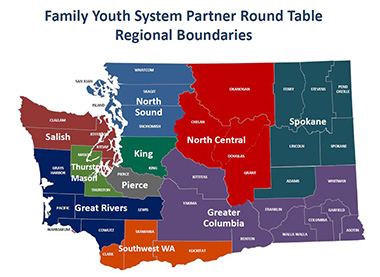
Find your regional FYSPRTs and learn how to get involved:
- Regional FYSPRT boundaries
- Find your regional FYSPRT
- Regional FYSPRT tri-lead contact list
- Regional FYSPRT manual (effective 07/01/2024, updated with new form 2/4/2025)
- Recurring gaps and needs form – Formerly the Challenge and Solution Submission Form, identifying recurring needs or gaps in services, used by the Regional FYSPRTs to share an unresolved recurring need or gap with the Statewide FYSPRT.
For regional FYSPRT websites, contact details, meeting schedules, check the following resources.
- Find your regional FYSPRT
-
Region
Regional FYSPRT Name
Coordinator
Meeting day and time
Location
Great Rivers
Ray Gregson
833-339-7778Second Monday
4:30 to 5:45 p.m.Online**
Greater Columbia
Salomon Carrasco
509-737-2457First Thursday
3:30 to 5 p.m.Online**
King
King County Community Collaborative - KC3
LaTonya Rogers
206-263-8934Fourth Tuesday 5:30 to 7:30 p.m.
Online**
North Central
Brian Rebar
509-885-6870Second Monday
5:30 to 7 p.m.Online, in person option quarterly**
North Sound
Val Jones
360-416-7013Second Monday
3 to 5 p.m.Online, some in person**
Pierce
HI-FYVE (Pierce FYSPRT)
Sienna Eckstrom
253-370-7757Fourth Monday
4 to 5:30 p.m.Tacoma and online**
Salish
Jessie Parsons
360-271-3472Last Monday
3 to 5 p.m.Online**
Southwest WA
Kacey Bellamy
509-864-7994Third Monday
4 to 6 p.m.Online and in Vancouver on even months**
Spokane
Becky Hammill
509-892-9241Third Thursday
3 to 4:30 p.m.Online**
Thurston Mason System of Care Partnership Donna Obermeyer
360-790-7505Fourth Friday - except November and December
10 a.m. to noonOnline, call in and in person in Olympia* **For additional information about regional FYSPRT meetings (date, time, in person or online participation information), please contact the regional FYSPRT coordinator for your region or visit the Regional FYSPRT website.
What is the difference between Regional FYSPRTs and the Statewide FYSPRT?
Ten Regional FYSPRTs work within their regions in Washington to complete a needs assessment. Each Regional FYSPRT also develops a work plan for addressing needs identified by their community and strategies for outreach and engagement of families and youth with lived experience, to be part of identifying and addressing needs. If a need keeps coming up in the needs assessment, meetings and/or while implementing the work plan and the Regional FYSPRT is not able to address it through their work plan, meetings or other strategies, then the Regional FYSPRT can move this need forward to the Statewide FYSPRT using the Recurring Gaps and Needs Form.
The Statewide FYSPRT receives Recurring Gaps and Needs Forms. Statewide FYSPRT members include Tri-leads from each Regional FYSPRT and state level system partners from different child serving systems who work together to gather information and brainstorm to address the recurring gap or need.
All Statewide FYSPRT meetings are led by Tri-leads that include a Family Tri-lead, a Youth Tri-lead and a System Partner Tri-lead.
FYSPRTs connection to legislative groups
When a Recurring Gaps and Needs Form is submitted by a Regional FYSPRT to the Statewide FYSPRT and the need is not able to be resolved by the Statewide FYSPRT then the issue is elevated to the legislative group known as the Youth and Young Adult Continuum of Care Subgroup (YYACC). All YYACC meetings are led by a team that include a Family Tri-lead, a Youth Tri-lead and two WA State Legislative Representatives. The YYACC is a subgroup of the Children and Youth Behavioral Health Work Group.
View the communication diagram for more information.
Statewide FYSPRT information
Vision
We envision a future where WA state youth, young adults, families, and community partners work together to ensure behavioral health programs and services successfully support all youth and families to thrive.
Mission
The Statewide FYSPRT represents all voices and strives to support the work of the regional FYSPRTs and resolve identified challenges from the regional FYSPRTs or advance them to a legislative group. We inspire hope, connection, provide education and resources for children's behavioral health.
Charter
View the Statewide FYSPRT charter.
Member list
FYSPRT members are active in communities across the state. Curious who's involved? Check out the member list.
Needs identified by the Statewide FYSPRT
The Statewide FYSPRT works to address recurring needs brought forward from a Regional FYSPRT through dialogue, presentations, and information gathering from other Regional FYSPRTs and state partners. If the Statewide FYSPRT is not able to resolve the recurring need, it can be moved forward to a legislative work group, specifically the Youth and Young Adult Continuum of Care (YYACC).
- Non-Emergency Medical Transportation (NEMT) | October 2023
-
In October 2023, this topic was dialogued about at the Youth and Young Adult Continuum of Care (YYACC) subgroup after coming forward from the Statewide FYSPRT. Customer service concerns around scheduling and transportation for youth/families continue to arise. This topic originally came to the Statewide FYSPRT in late 2021 and in 2022 a request was sent by the Statewide FYSPRT Tri-leads to Regional FYSPRTs and state system partners to gather info from their regions/systems to identify any themes around strengths or concerns related to NEMT. Information received was compiled and shared at the March 2022 Statewide FYSPRT with NEMT representatives present. NEMT also received detailed responses received from Regional FYSPRTs and system partners. NEMT encouraged transportation contractors to connect with Regional FYSPRTs about any concerns. How to Find Your Regional FYSPRT information was shared with NEMT to assist with connecting transportation brokers/contractors with Regional FYSPRTs. Although some progress was made addressing this need, the challenge came forward to the Statewide FYSPRT again in 2023. The Statewide FYSPRT Tri-leads requested updated information from the Regional FYSPRTs and state system partners around any recurring needs related to NEMT since the prior information request in 2022. NEMT representatives attended the August 2023 Statewide FYSPRT to present updated information and dialogue about concerns, identifying that they had submitted a funding request to help address some of the recurring customer service concerns. The Youth and Young Adult Continuum of Care (YYACC) subgroup sent this topic and information about the funding request forward to the Children and Youth Behavioral Health Work Group (CYBHWG) who approved a statement of support for the funding request (see page 14 of the 2024 report to view the statement of support). $7 million in funding was awarded as part of the 2024 legislative process. Transportation brokers received an increase in their administrative payment starting July 2024 and have been able to staff up their call centers. This has resulted in improved call center performance. Starting July 1, 2025, a call center disincentive will assess monetary fines if brokers fall below 80% of calls being answered within five minutes. Brokers are periodically attending FYSPRT meetings to provide direct assistance and make immediate connections so concerns can be quickly addressed. In addition, as part of the 2024 legislative process, Second Substitute Senate Bill 6228 was passed directing HCA to complete a gaps analysis of non-emergency transportation benefits provided to Medicaid enrollees in Washington, Oregon, and other comparison states (as selected by the Health Care Authority) including the option of an enhanced non-emergency transportation benefit for people being discharged from behavioral health emergency services. It also states that HCA shall evaluate the possibility of creating a network of peer-led, trauma informed transportation providers that could provide non-emergency transportation to youth and adult medical assistance patients traveling to receive behavioral health services. This gaps analysis/report has been posted to the HCA Legislative Reports page and is titled Non-Emergency Medical Transportation (NEMT): Overview and gap analysis.
- Neuropsychological evaluation wait times | November 2021
-
In November 2021, information from the Statewide FYSPRT was presented to the Youth and Young Adult Continuum of Care (YYACC) subgroup regarding neuropsychological evaluation wait times, which were partially due to the low rate of Medicaid reimbursement. Experts from Seattle Children’s and Molina attended the YYACC meeting to dialogue about the topic. An update was provided at the January 2022 Statewide FYSPRT meeting identifying that the YYACC would resume work on this after the 2022 legislative session ended. In 2022, the Children and Youth Behavioral Health Work Group (CYBHWG) recommended a 7% rate increase in Medicaid reimbursement for community behavioral health providers contracted through managed care organizations (MCOs), retroactive to January 1, 2022 (see page 3 of the 2022 report). In 2023, additional funds to implement a 15% increase to Medicaid reimbursement for community behavioral health providers contracted through managed care organizations (MCOs) was approved with an effective date of January 1, 2024 (see page 3 of the 2023 report). This resulted in an increase in the payment for neuropsychological testing evaluation services from $75.96 in 2021 to $91.23 in 2024.
For more information, go to HCA’s Provider billing guides and fee schedules.
- Behavioral health respite for youth and families | August 2020
-
Respite briefing paper with information gathered from the Statewide FYSPRT was presented to Youth and Young Adult Continuum of Care (YYACC) subgroup in August 2020. YYACC Subgroup recommended to the larger Children and Youth Behavioral Health Work Group (CYBHWG), a legislative group, to direct the Health Care Authority (HCA) to explore Medicaid waiver options for respite care for youth with behavioral health needs, without adversely impacting the Developmental Disabilities Administration and Department of Children, Youth and Families respite waivers. In 2021, the HCA was directed by the legislature to contract for a report which would review the options for providing behavioral health respite in Washington. This report was completed in June 2022 and is titled Behavioral Health Respite Implementation – Authority Options. As an alternate, there is also a one-page summary available titled Status update: Behavioral Health respite options. HCA reviewed the options which included the Medicaid Transformation Project (MTP) which is Washington’s Section 1115 Medicaid demonstration waiver between HCA and the Centers for Medicare and Medicaid (CMS). MTP allows HCA to create and continue to develop projects, activities and services that improve Washington’s health care system for those enrolled in Apple Health/Medicaid. HCA included caregiver respite in the MTP waiver application to CMS. In 2024, the 1115 Medicaid Transformation waiver application was partially approved. A representative from the MTP project attended and provided an update at the December 2024 Statewide FYSPRT meeting. For more information, see the December 10, 2024 Statewide FYSPRT meeting notes.
Statewide FYSPRT meetings
The Statewide FYSPRT meets every other month. Meetings are open to the public and representatives from legislative groups, specifically the Youth and Young Adult Continuum of Care and Children and Youth Behavioral Health Work Group (CYBHWG) are invited to attend.
The 2026 meeting schedule will be updated if meeting details change or if a meeting is canceled due to weather or other circumstances.
| Date | Location | Materials |
|---|---|---|
|
Tuesday, February 3, 2026 3 to 5 p.m. |
Online | Meeting agenda (02/03/2026) |
|
Tuesday, April 7, 2026 3 to 5 p.m. |
Online | |
|
Tuesday, June 2, 2026 3 to 5 p.m. |
Online | |
|
Tuesday, August 4, 2026 3 to 5 p.m. |
Online | |
|
Tuesday, October 6, 2026 3 to 5 p.m. |
Online | |
|
Tuesday, December 1, 2026 3 to 5 p.m. |
Online |
Past meetings
- 2025
-
Date Materials Tuesday, December 2, 2025 Tuesday, October 7, 2025 Meeting notes (10/7/2025) Tuesday, August 5, 2025 Meeting notes (8/5/2025) Tuesday, June 3, 2025 Meeting notes (6/3/2025) Tuesday, April 1, 2025 Meeting notes (4/1/2025) Tuesday, February 4, 2025
- 2024
-
Date Materials Tuesday, December 10, 2024 Thursday, September 26, 2024 Thursday, July 25, 2024 Thursday, May 23, 2024 Thursday, March 28, 2024 Thursday, January 25, 2024 Meeting notes (1/25/2024) - 2023
-
Date Materials Thursday, October 26 Meeting notes (10/26/2023) Thursday, August 31 Meeting notes (08/31/2023) Thursday, June 22 Meeting notes (06/22/2023) Thursday, April 27 Meeting notes (04/27/2023) Thursday, February 23 Meeting notes (02/23/2023)
Related resources and support
Webinars
Hosted by Youth MOVE National.
- Community mapping in Washington – Identify local resources and connections.
- Recruitment and Retention of Youth Leaders – Strategies to engage and support youth leaders.
- Gauging Intentional Youth – Adult Partnerships – ways to measure youth engagement and the importance of partnership between young people and adult supporters.
- Foundations of youth engagement – Key principles for meaningful youth involvement.
- Virtual youth engagement – creating empowering virtual environments for youth and young adults.
Tools to strengthen FYSPRTs and youth engagement
- FYSPRT recruitment template – A guide to growing your team.
- FYSPRT evaluation tool – Measure the impact and effectiveness of your FYSPRT meetings.
- FYSPRT team effectiveness questionnaire – Identify meeting strengths and areas for growth.
(Updated January 9, 2026)